
SpongeScan - Deciphering the role of glass SPONGEs in the carbon and Silicate cycle of a Changing ANt-arctic.
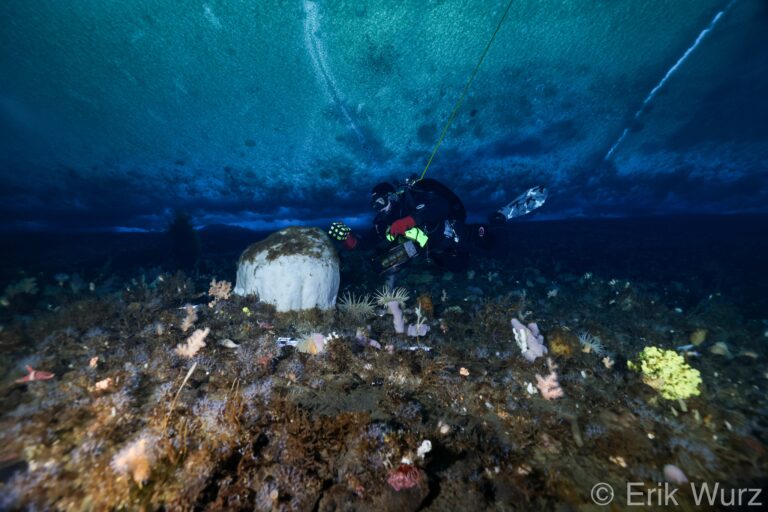
Large glass sponges (hexactinellids) are formative structural elements of the benthic communities of the Antarctic shelf, helping to create habitat for a rich associated fauna. Glass sponge communities mostly colonise zones of high primary productivity, such as the ice shelves in the Ross and Weddell Seas. However, the mechanisms linking primary production to sponge growth are still unknown. Carbon and silicate probably limit the distribution and growth rate of these unique glass sponge communities on the Antarctic shelf, most of which occur in water hundreds of meters deep. McMurdo Sound in the Ross Sea, however, includes locations where large hexatinellids can be found at depths of less than 30 metres, allowing research divers access.
In collaboration with the Alfred-Wegener-Institute, New Zealand scientists, and the FSDA, the feeding relationships are being analysed by scientific divers using largely non-destructive, underwater measurements. Water samples are taken from immediately next to the sponge (before filtration) and from the central cavity of the sponge (after passage through the sponge tissue) and are analysed for food and nutrients including silicate. The pumping rate is measured with ADVs, while the volume of the sponges is computed by creating 3-dimensional photogrammetric reconstructions, which can be used to estimate biomass. The combined results will increase the understanding of the role of these sponges in the carbon and silicate cycle.
- Energy Transition Fund
- 2024-2026
- Partner
- Nils Jacobsen
Partners:
Alfred-Wegener-Institute, Antarctica New Zealand, Finish Scientific Diving Academy, Royal Belgian Institute of Natural Sciences